
-
by sayum
03 October 2026 9:56 AM







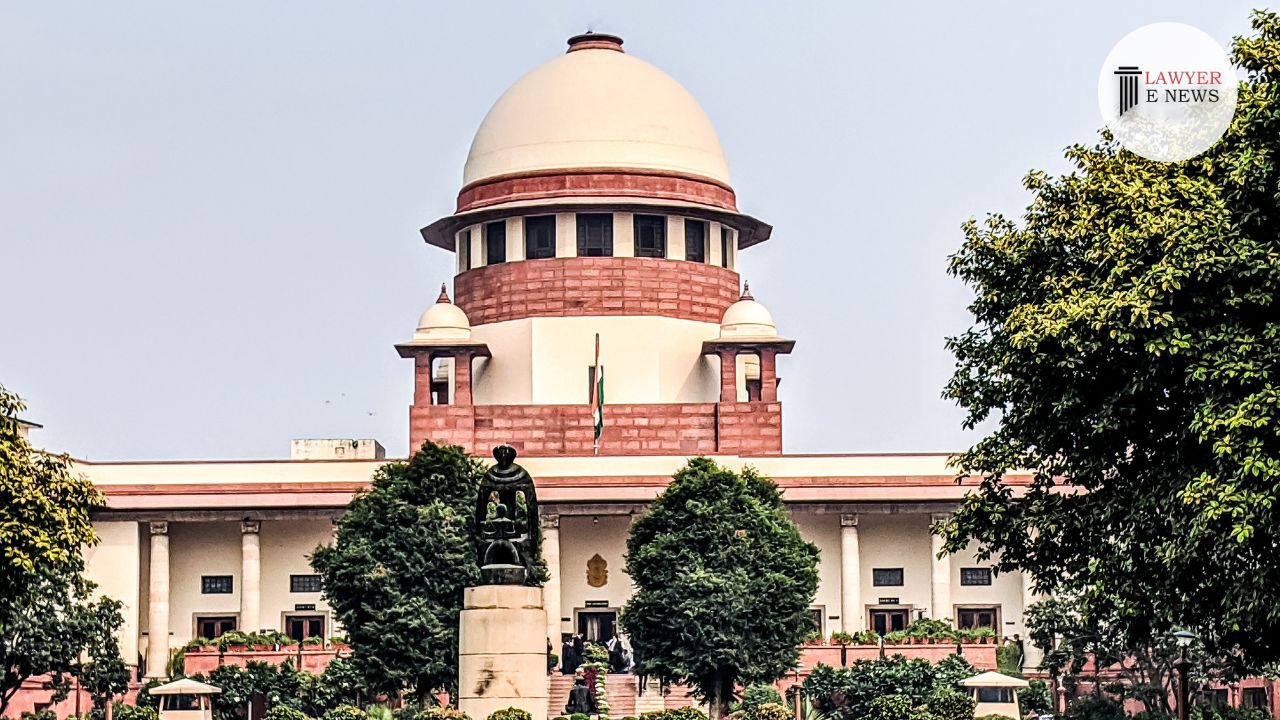
Supreme court in a latest Judgement (THE STATE OF CHATTISGARH & ANR. Vs. AMAN KUMAR SINGH & ORS. ETC. D.D. 1March 2023) emphasizes the importance of punishing corrupt public servants and upholding the high standards expected of those in positions of trust and responsibility. The court acknowledges the difficulty of eradicating corruption but emphasizes the duty of the Constitutional Courts to show zero tolerance towards corruption while protecting innocent public servants. The court expresses hope for better times in the future. (Para No. 48, 49)
The Supreme Court of India has heard five appeals regarding a judgment passed by the Chhattisgarh High Court in Bilaspur. The appellants include the State of Chhattisgarh and Uchit Sharma, who question the common judgment and order passed by the high court on January 10, 2022. The judgment disposed of three writ petitions, including one filed by Aman Singh, which resulted in the quashing of FIR No. 9/2020.
A complaint alleged that Aman Singh, a former Principal Secretary to the Chief Minister of Chhattisgarh, and his wife, Yasmin Singh, were involved in corruption and money laundering. The complaint was forwarded to the Anti-Corruption Bureau for inquiry. Yasmin Singh filed a writ petition challenging a departmental inquiry initiated against her, The High Court granted her stay by an order dated January 16, 2020.
In January 2022, the High Court allowed the quashing of the FIR in WPCR 88/2020 . The High Court directed that AS's bank account would be inoperative after the FIR was quashed in WPCR 88/2020.
The Supreme court expresses concern about the prevalence of corruption in Indian society, which is a major obstacle to achieving social justice and equal distribution of wealth and identifies greed as the root cause of corruption and notes that corruption is not limited to the government but has become a way of life for many.
The court emphasizes the importance of punishing corrupt public servants and upholding the high standards expected of those in positions of trust and responsibility. The court acknowledges the difficulty of eradicating corruption but emphasizes the duty of the Constitutional Courts to show zero tolerance towards corruption while protecting innocent public servants. The court expresses hope for better times in the future. (Para No. 48, 49)
The Supreme Court observed that to understand the merits of a controversy, one must first read the relevant provisions of the Prevention of Corruption Act (P.C. Act). The Act defines a "public servant" and it is undisputed that the individuals in question are comprehended within this definition. Section 13(1) of the Act defines "criminal misconduct" and includes intentional illicit enrichment by a public servant during their period of office. If a public servant is found to be in possession of pecuniary resources or property disproportionate to their known sources of income and is unable to satisfactorily account for them, they shall be liable to be proceeded against for having committed criminal misconduct and suitably punished and fined if the charge is proved. This is a presumptive finding based on being a public servant, being in possession of disproportionate assets during the period of their office and being unable to satisfactorily account for them. The Court notes that the law of the land abhors such conduct by public servants and any increase in their assets is constitutionally impermissible conduct. (para No.50,51)
The Supreme Court explains that in cases where an FIR is registered based on a preliminary inquiry into the complaint of a US (unknown person), materials need to be collected during the investigation to establish possession of pecuniary resources or acquisition of assets disproportionate to the public servant's known sources of income. It is during this investigation that evidence can be collected to lay a police report under section 173(2) of the Cr.P.C. At the preliminary inquiry stage, investigative powers are barred, and the inquiry is intended to help form an opinion on whether an FIR needs to be registered. (Para 52)
Paragraph 53: The Supreme Court refers to Section 13 of the P.C. Act and the principles discussed earlier to assess whether a cognizable offense has been made out against AS and his wife YS based on the FIR and preceding complaint.
Paragraph 54: The complaint lodged by US alleges that AS, despite coming from a humble background, has amassed assets of over 2500 crores disproportionate to his legal sources of income. The court notes that this is a tall claim that is not substantiated, but it cannot be disregarded due to the revelations of the preliminary inquiry that led to the registration of the FIR.
Supreme Court finds that the FIR indicates that the check period during which AS and YS acquired disproportionate assets is from 2004 to 2018. The FIR also details calculations projecting the amount of money both individuals received towards salaries, interest, and property sales. Immovable properties acquired by AS and YS in different locations with their prices are mentioned. The FIR also refers to possible investments made by AS abroad and deposits of money in lakhs in YS's bank account suspected to be profits from investments involving significant amounts. The FIR also mentions financial transactions involving huge amounts by Cargill India Pvt. Ltd. and Courtesan Consulting Private Limited, deposited in YS's bank account, which require scrutiny.
Supreme court also observed that drafting of the FIR could have been better, as a poorly drafted FIR can potentially scuttle the investigative process. Believes that in this particular case, the errors in the FIR are not significant enough to affect the case against AS and YS. AS and YS are free to point out any errors or inaccuracies in the FIR during the investigation, but they chose to challenge the FIR instead.
Supreme Court disagrees with the High Court's decision to quash the FIR. The High Court believed that the FIR was based on probabilities rather than definite facts and figures and did not clearly demonstrate the commission of any offence under Section 13(1)(b), 13(2) of the Act, 1988. The author of this passage, however, is unable to appreciate the reasons behind the High Court's decision and believes that the FIR does make out a case of cognizable offence committed by AS and YS. 57
Supreme Court observed that the High Court did not exercise caution while deciding the challenge to the FIR, and did not bear in mind the principle that the power of quashing a criminal proceeding should be exercised sparingly and in rare cases. The court emphasized that the High Court should not embark on an inquiry into the reliability or genuineness of the allegations made in the FIR or the complaint.
The Supreme Court reiterated the need for the High Courts to bear in mind the settled principle of law that they should not inquire into the probability, reliability, or genuineness of the allegations made in an FIR or complaint while exercising their powers under Article 226 of the Constitution or Section 482 of the CrPC for quashing a criminal proceeding.
The court examines the challenge to the FIR on the grounds of mala fides and finds that the writ petitions before the High Court would not have succeeded even if the plea of mala fide were advanced and accepted as a ground of assail to the FIR. The court notes that the pleadings are insufficient to return a finding that the FIR is an outcome of mala fide, as the allegations against the government and the Chief Minister are vague and general in nature. The person against whom mala fide or bias is imputed should be impleaded as a party respondent to the proceedings and that in his/her absence no inquiry into the allegations can be made.
The court concludes that when an information is lodged at the police station and an offence is registered in respect of a disproportionate assets case, it is the material collected during the investigation and evidence led in court that is decisive for determining the fate of the accused, and that whether the first information report is the outcome of mala fide would be of secondary importance. The court emphasizes that if criminal prosecution is based upon adequate evidence and the same is otherwise justifiable, it does not become vitiated on account of significant political overtones and mala fide motives.
Appeal Allowed.
THE STATE OF CHATTISGARH & ANR. Vs. AMAN KUMAR SINGH & ORS. ETC.