-
by sayum
28 August 2026 2:11 PM







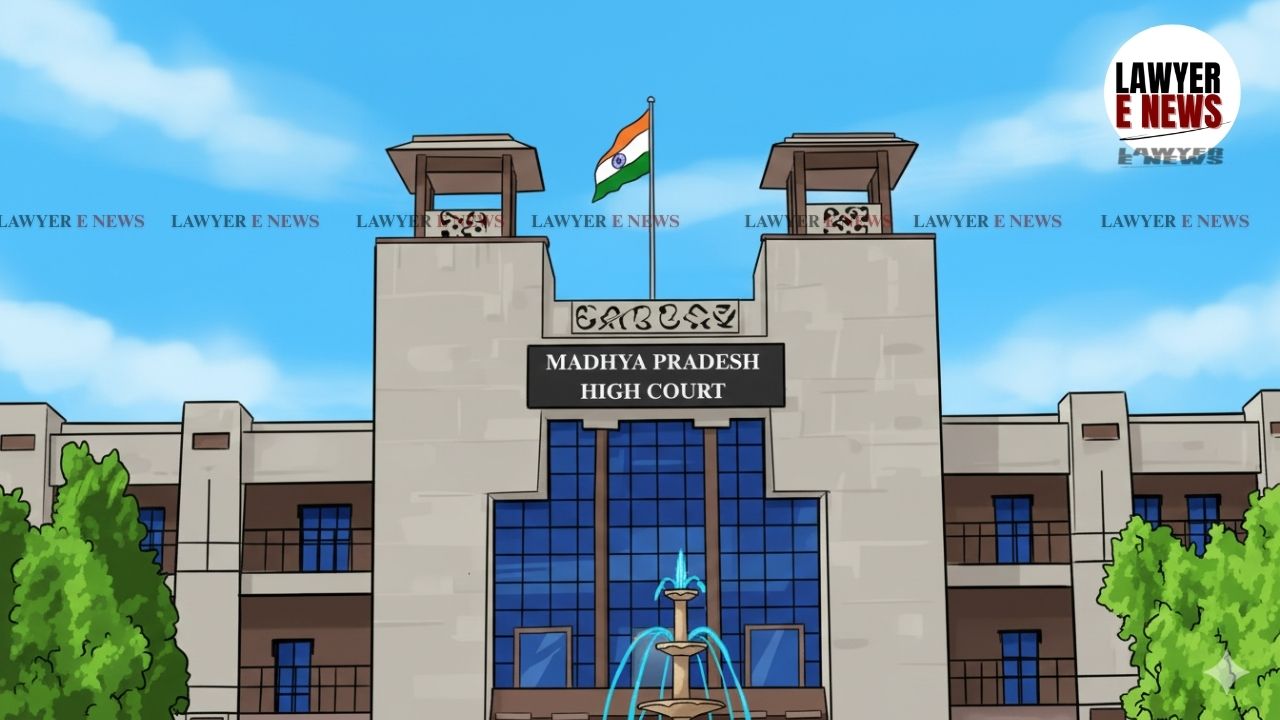
"Religious character of disputed area of the Bhojshala Complex and Kamal Maula Mosque is held to be a Bhojshala with a temple of goddess Vagdevi (Saraswati), " Madhya Pradesh High Court, in a landmark verdict, declared the entire disputed Bhojshala complex in Dhar to be a temple of Goddess Vagdevi (Saraswati), effectively quashing a decades-old arrangement that permitted Muslim prayers at the site.
A Division Bench comprising Justice Vijay Kumar Shukla and Justice Alok Awasthi held that the complex was originally constructed as a centre of Sanskrit learning and a Hindu temple in 1034 AD during the regime of Raja Bhoj. The Court observed that "the existing structure was made from the parts of earlier temples" and that Islamic architectural features were later insertions.
The proceedings involved a batch of consolidated writ petitions and an appeal filed by various parties, including the 'Hindu Front for Justice' and representatives of the Jain community. The core dispute centered on the "disputed area" of Bhojshala and Kamal Maula Mosque, which had been a flashpoint for communal tension for decades. The matter reached the High Court following an extensive scientific survey conducted by the Archaeological Survey of India (ASI) under the Court's directions.
The primary questions before the court were whether the property originally vested in a deity continues to be the deity’s property and whether any construction raised after demolishing a temple can be termed a mosque. The Court was also called upon to determine the "religious character" of the monument as it existed on August 15, 1947, and the validity of administrative orders issued by the ASI in 2003.
ASI's 2003 Order Found Ultra Vires Section 16 Of 1958 Act
The Court heavily criticized the order dated April 7, 2003, passed by the Director-General of the ASI, which restricted Hindu worship to Tuesdays and permitted Namaz on Fridays. The Bench noted that the ASI had a mandatory statutory duty under Section 16 of the Ancient Monuments and Archaeological Sites and Remains Act, 1958, to ascertain the true character of a monument before regulating its usage. The Court observed that the 2003 order was issued "without any prior survey or study" and was thus contrary to the mandate of the Act.
The Bench emphasized that Section 16(1) of the 1958 Act requires a protected monument which is a place of worship to be used in a manner consistent with its religious character. Since the ASI failed to determine the site's original character before passing the 2003 order, the Court found the restriction on Hindu worship to be legally unsustainable. The judges remarked that "the starting point of applicability of Section 16 is the ascertainment of the true character, nature and form of the place."
Scientific Survey Conclusively Establishes Temple Origin
Relying on the ten-volume scientific report submitted by the ASI, the Court noted that the present structure stands over a pre-existing large structure dating back to the Paramara period (10th-11th Century CE). The GPR survey and stratigraphic analysis revealed three distinct architectural phases, with the current superstructure being a later modification. The Court highlighted that the ASI retrieved 94 sculptures and fragments, including images of Ganesha, Brahma, and Narasimha, which "are not permissible in a mosque" and had been deliberately defaced.
The Court found that more than 150 Sanskrit and Prakrit inscriptions were discovered at the site, many of which were damaged and reused as floor slabs. One such inscription specifically referred to the "Sharada Sadan" (temple of learning). The Bench held that these findings corroborated the historical literature suggesting that the site functioned as a Sanskrit school and temple dedicated to Goddess Saraswati long before any Islamic invasion.
Places Of Worship Act 1991 Not Applicable To Protected Monuments
Addressing the objection raised by the Muslim community regarding the bar under the Places of Worship (Special Provisions) Act, 1991, the Court held that the Act does not apply to the Bhojshala complex. The Bench pointed to Section 4(3)(a) of the 1991 Act, which specifically excludes ancient and historical monuments or archaeological sites covered by the 1958 Act. Since the Bhojshala had been a protected monument since 1904, it fell within this statutory exception.
The Court observed that the power of judicial review under Article 226 of the Constitution of India is part of the basic structure and cannot be overridden by the 1991 Act. It further noted that the petitions did not seek a "conversion" of the place of worship but rather a declaration of its existing character. The Bench stated that "the bar under the Act 1991 would not apply to such disputed area which is notified as a protected monument under the Act of 1958."
1935 Dhar State Ailan Held Legally Invalid
The respondents had relied on an "Ailan" (notification) issued by the Ruler of the Dhar State in 1935, which recognized the structure as a mosque. However, the High Court held that this Ailan was merely an executive arrangement and not a legislative enactment. The Bench observed that for a pre-constitutional instrument to survive, it must possess legislative character and satisfy the requirements of Article 372 of the Constitution of India.
The Court held that since the monument was already protected under the 1904 Act at the time, the Dhar Ruler lacked the jurisdiction to alter its character via an executive order. The Bench further noted that the Ailan was inconsistent with the fundamental rights guaranteed under the Constitution and was therefore void under Article 13. The judges remarked that "the order dated August 24, 1935, cannot override constitutional principles and cannot be treated as a binding legislative document."
Recognition Of Deity As Juristic Person And Right To Worship
The Court reiterated the principle from the Ayodhya judgment that a deity is a juristic person with its own rights to be protected from desecration. The Bench held that "once the property vested in a deity, the same continues to be the deity’s property." The Court found that the right of Hindus to perform puja daily was a fundamental right under Article 25, which had been arbitrarily curtailed by the ASI’s 2003 administrative arrangement.
Regarding the claims of the Jain community that the idol was actually Goddess Ambika, the Court held that even if such iconographic similarities existed, it did not establish the complex as a Jain temple. The Bench noted that Jainism and Hinduism have evolved side by side and that the discovery of a Jain Tirthankara statue within a larger Hindu temple complex was "entirely natural" and did not detract from the primary character of the Saraswati temple.
Final Directions And Allotment Of Alternative Land For Mosque
While allowing the petitions of the Hindu Front and Kuldeep Tiwari, the Court issued several mandatory directions. It ordered the Government of India to take a decision on the management of the Bhojshala temple and Sanskrit learning center. The Court also directed the government to consider diplomatic representations to bring back the original "Pratima" of Goddess Saraswati, which is currently housed in the British Museum in London.
To ensure complete justice and secure the religious rights of the Muslim community, the Court directed the State Government to consider allotting a "suitable and permanent" part of land within the Dhar district for the construction of a mosque. This application, if submitted by the respondent No. 8 or a duly constituted Waqf body, is to be considered in accordance with the law to provide a place for prayer for the community.
The High Court concluded that the Bhojshala-Kamal Maula complex is a protected monument with the religious character of a temple dedicated to Goddess Saraswati. The petitions by the Hindu Front for Justice and Kuldeep Tiwari were allowed, while the petitions from the Jain community and the Maulana Kamaluddin Welfare Society were dismissed. The ruling marks a definitive judicial determination on the status of the centuries-old monument, shifting its management from a shared-usage model to an exclusive Hindu temple and learning center.
Date of Decision: 15 May 2026