-
by sayum
24 August 2026 11:13 AM







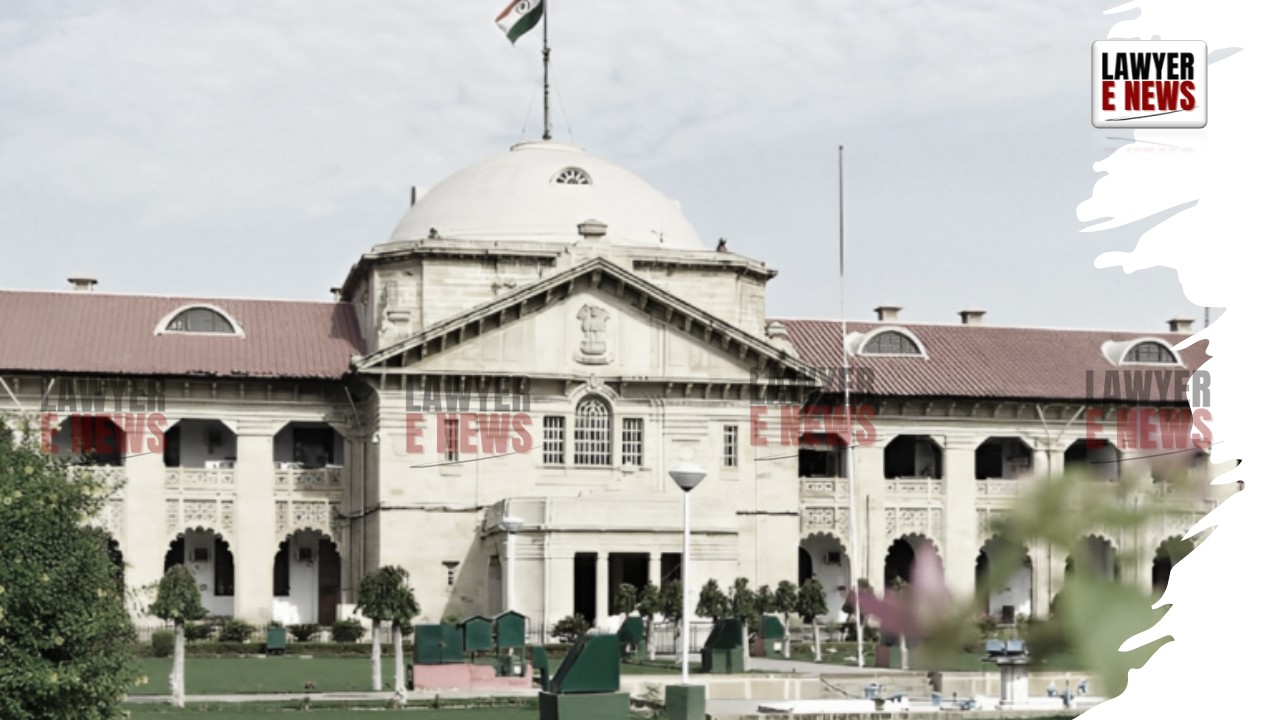
“Mere Lack of Recognition Cannot Justify Closure of a Minority Institution That Seeks No Aid” – In a significant reaffirmation of minority rights under the Constitution, the Allahabad High Court (Lucknow Bench) on January 16, 2026, in C/M Madarsa Ahle Sunnat Imam Ahmad Raza v. State of U.P. & Others, Writ-C No. 307 of 2026, quashed the District Minority Welfare Officer’s order directing closure of a privately-run unrecognized Madarsa in Shrawasti.
Justice Subhash Vidyarthi held that the State has no authority under law to shut down an unrecognized religious educational institution that neither seeks government aid nor recognition, and such functioning is squarely protected by Article 30(1) of the Constitution of India.
“Non-recognition may disentitle a Madarsa from receiving government grants or state-backed benefits, but it does not empower the State to forcibly shut down the institution,” the Court ruled, directing that the seal placed on the Madarsa be removed within 24 hours.
“Unrecognized Minority Institutions Cannot Be Compelled to Shut Down for Lack of Recognition”
The petitioner, a privately-run religious institution operating under the name C/M Madarsa Ahle Sunnat Imam Ahmad Raza, had approached the Court challenging the closure order dated 01.05.2025 issued by the District Minority Welfare Officer, Shrawasti. The authority had directed that the Madarsa be closed on the ground that it was being operated without recognition under the U.P. Non-Governmental Arabic and Persian Madarsa Recognition, Administration and Services Regulation, 2016.
The petitioner contended that it neither sought recognition nor applied for government aid, and hence, fell within the category of fully autonomous minority institutions as recognised by the Supreme Court. It was argued that the only consequence of non-recognition under Regulation 13 of the 2016 Regulations was that the institution would not be eligible for government grant-in-aid, and that there was no provision authorizing closure of such an institution.
“Constitutional Protection Applies to Those Seeking Neither Aid Nor Recognition” – Reliance on Supreme Court’s Latest Ruling in Anjum Kadari
The Court placed strong reliance on the Supreme Court’s recent decision in Anjum Kadari v. Union of India, (2025) 5 SCC 53, which in turn re-affirmed the earlier constitutional position laid down in the Kerala Education Bill, 1957.
“Minority educational institutions have been classified into three categories: (i) those which do not seek either aid or recognition from the State; (ii) those which want aid; and (iii) those which want only recognition but not aid. The first category is fully protected by Article 30(1),” observed the Court.
Justice Vidyarthi held that the petitioner Madarsa fell squarely within the first category, as it had neither sought recognition nor applied for aid, and thus, the State had no jurisdiction to interfere with its right to establish and administer the institution.
“Absence of Statutory Power Renders Executive Action Invalid” – Administrative Concerns Cannot Override Fundamental Rights
The State argued that the running of an unrecognized Madarsa may create confusion for students, especially with regard to their qualifications and eligibility for future opportunities. However, the Court was not persuaded.
“Although the learned Additional Chief Standing Counsel vehemently opposed the writ petition, he could not dispute the fact that there is no provision in the 2016 Regulation enabling the authorities to stop the functioning of a Madarsa on the ground that it is not recognized,” the Court stated.
The executive order, having no basis in statute, was held to be unsustainable in law. The Court reaffirmed the settled principle of administrative law that an executive action must be rooted in statutory authority, and in its absence, any such action amounts to excessive and unlawful interference.
Relief Granted with Important Clarifications
While quashing the closure order dated 01.05.2025, the Court issued clear clarifications to protect public interest and avoid any misunderstanding regarding the legal implications of non-recognition:
“It is clarified that the petitioner Madarsa will not be entitled to claim any government grant till it is recognized, and the Madarsa Board will not be obliged to permit its students in the examinations conducted by the Madarsa Board.”
The Court further noted: “Students of the Madarsa will not be entitled to claim the benefit of their qualification acquired from the Madarsa for any purposes relating to the State Government.”
Despite these limitations, the right to continue operating the Madarsa without recognition or aid remains fully protected.
Accordingly, the Court directed the authorities to remove the seal placed on the Madarsa premises within 24 hours of production of a certified copy of the judgment.
A Clear Reaffirmation of Minority Autonomy Under Article 30(1)
This ruling fortifies the constitutional protection granted to minority-run religious and linguistic institutions, particularly those choosing to remain unaided and unrecognized by the State. It draws a sharp line between regulatory denial of benefits and state overreach into constitutionally protected zones.
“The functioning of a minority institution that seeks neither recognition nor aid is a matter of constitutional autonomy, not administrative discretion,” the Court essentially reaffirmed.
The decision serves as a reminder that executive anxiety about compliance or standardization cannot trump constitutional freedoms, especially in the domain of minority rights and religious education.
Date of Decision: 16 January 2026