-
by sayum
04 August 2026 1:39 PM







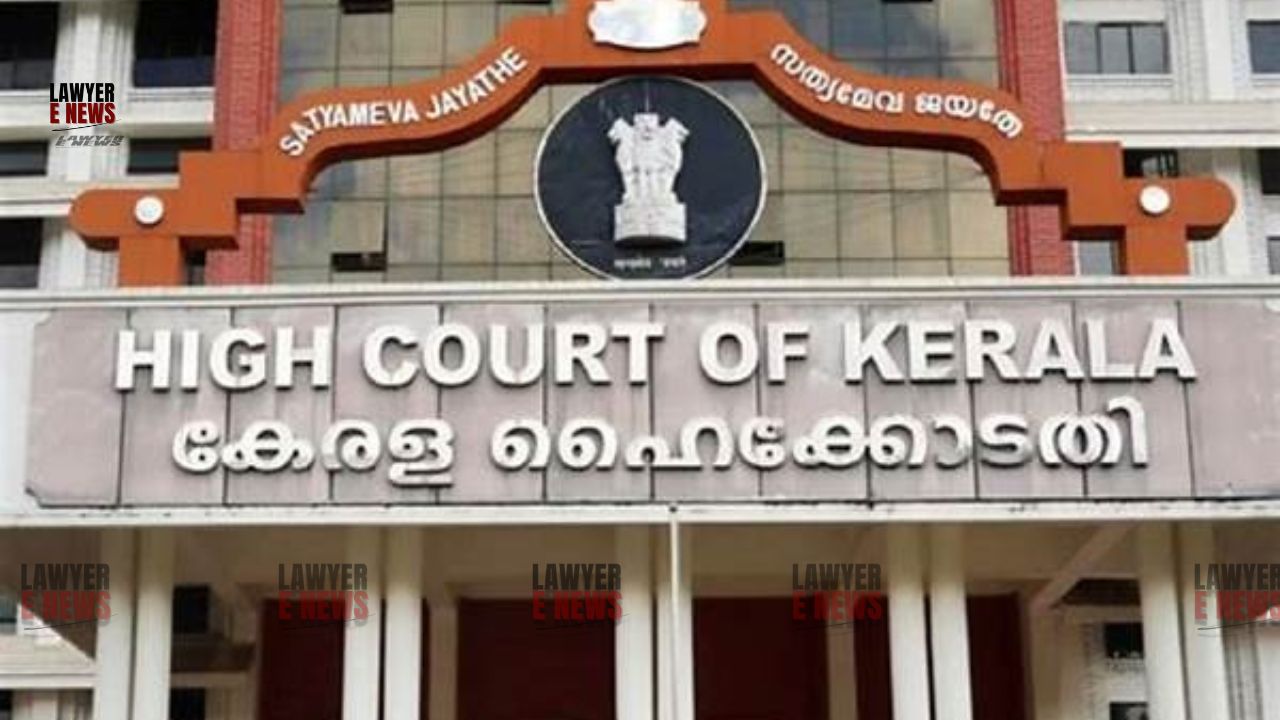
“Errors Must Be Self-Evident, Not Debatable” – Kerala High Court, in a detailed and reasoned judgment, dismissed two review petitions filed by Angel Mary J.N. and Kripa K.K., challenging the Court’s earlier common judgment dated 04.10.2024 in OP(KAT) Nos. 349 and 367 of 2024. The Court, comprising Justice Anil K. Narendran and Justice P.G. Ajithkumar, reaffirmed that only those candidates with declared probation were eligible for appointment by transfer to the post of Assistant Professor in Nursing, and dismissed the petitioners’ attempt to reopen the matter through review.
Holding that no error apparent on the face of record was shown under Order XLVII Rule 1 of the Code of Civil Procedure, the Court emphasized:
“A review petition has a limited purpose and cannot be allowed to be an appeal in disguise.”
Background of the Case:
The review petitions were filed under Section 114 read with Order XLVII Rule 1 CPC, in relation to the High Court’s common judgment which had upheld the eligibility criterion of declared probation for candidates seeking appointment by transfer to the post of Assistant Professor in Nursing.
The petitioners, both working in government service, contended that candidates from both the Department of Health Services and the Department of Medical Education were eligible feeder categories. They argued that probation should not have been made a threshold requirement and that direct recruitment was the appropriate mode given the nature of the vacancy.
Legal Issues and Court's Observations:
The central questions were:
Whether the requirement of declared probation for transfer appointment was an error apparent on the face of the record.
Whether the PSC was wrong in opting for appointment by transfer instead of direct recruitment.
Whether Rule 2(13) or Rule 5 of the Kerala State and Subordinate Services Rules, 1958 (KS&SSR) governed the eligibility.
The Court found no merit in the review petitions. It reiterated that the eligibility condition of declared probation had already been upheld after full consideration of applicable rules and precedents. Referring to the ruling in Parison Devi v. Sumitri Devi, (1997) 8 SCC 715, the Court noted:
“An error which is not self-evident and has to be detected by a process of reasoning can hardly be said to be an error apparent on the face of the record.”
The Court held that the contentions raised in the review were identical to those already argued and decided in the original petitions, and therefore, were not reviewable. Quoting from Shanti Conductors Pvt. Ltd. v. Assam SEB, (2020) 2 SCC 677, the Court underscored:
“Under the guise of review, the petitioner cannot be permitted to reagitate and reargue the questions which have already been addressed and decided.”
On Recruitment Mode and Application of Rules:
The petitioners argued that Rule 5 (governing the ratio between direct recruitment and transfer) should apply, and that Rule 2(13) (defining ‘appointment by transfer’) had been wrongly applied.
The Court disagreed, holding:
“Rule 5 regulates only the proportion and does not create any prohibition to recruitment by transfer vis-a-vis the substantive vacancies.”
It observed that when special rules provided for transfer appointments, the recruitment agency (in this case, the PSC) acted within its statutory authority. The notification for by-transfer recruitment was therefore valid, and the contention that it should have been a direct recruitment was rejected as misconceived.
The Court also found that the interpretation of Rule 2(13) was consistent with established precedent, including the Court's own judgment in O.P.(KAT) No. 293 of 2024, where similar contentions had been rejected and review refused.
No Scope for Reappraisal or New Contentions:
The Court further noted that the petitioners attempted to introduce new arguments in the review, which were never raised earlier. Such conduct, it held, fell outside the scope of review jurisdiction:
“There is no scope for such new contentions in an application for review.”
Referring to Deva Metal Powders Pvt. Ltd. v. CTT, (2008) 2 SCC 439, the Court reiterated:
“A wrong view or decision taken in the judgment cannot be a reason for review, inasmuch as a review cannot be an appeal in disguise.”
The Kerala High Court conclusively dismissed both review petitions, holding that no manifest error, no jurisdictional defect, and no self-evident mistake had been demonstrated. The judgment strongly reaffirms the limited and narrow scope of review under Order XLVII Rule 1 CPC, and discourages litigants from using the mechanism of review as a backdoor appeal.
“Accordingly, these applications for review are dismissed.”
Date of Decision: 02 June 2025