
-
by sayum
26 August 2026 1:49 PM







“A Single Judge Cannot Sit in Judicial Isolation on Matters Affecting Thousands”: Supreme Court of India issued a decisive ruling by transferring the probe into the Karur stampede tragedy—in which 41 lives were lost and over 100 injured during a political rally held by the Tamilaga Vettri Kazhagam (TVK)—to the Central Bureau of Investigation (CBI). In doing so, the Court sent an unambiguous message: “Public faith in criminal investigation cannot be built on foundations of conflicting judicial orders and perceived institutional bias.”
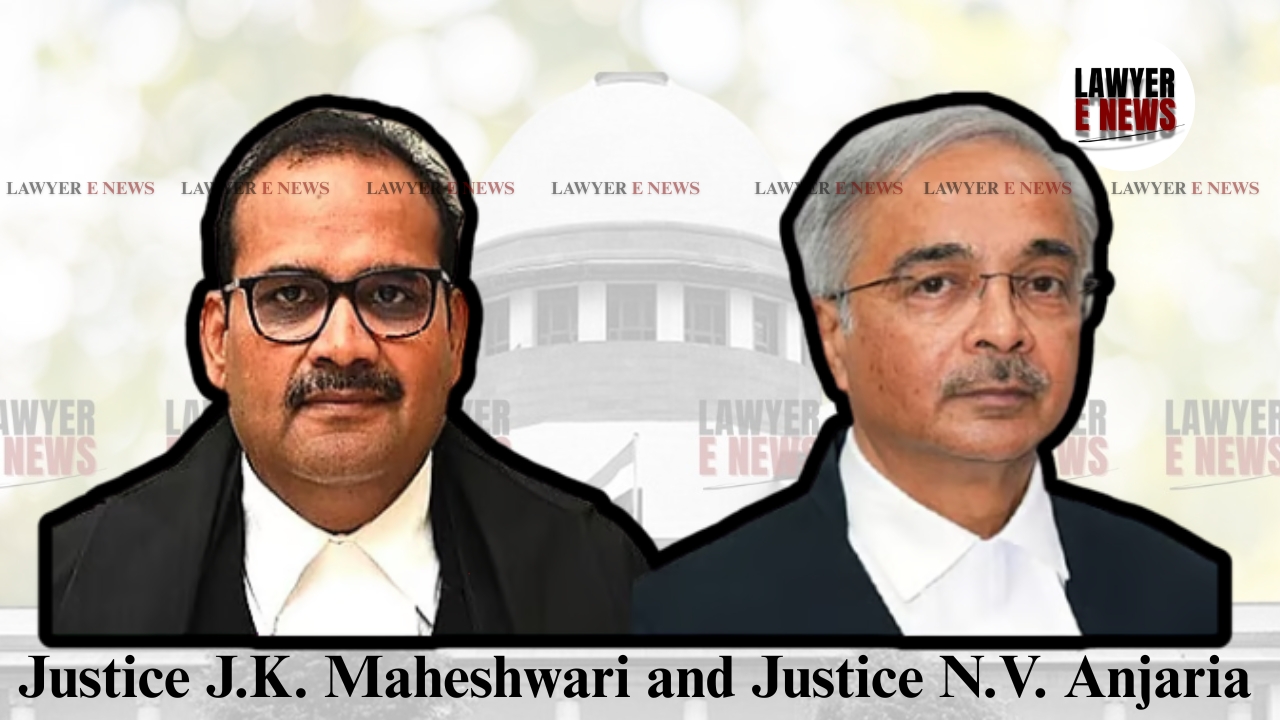
The Court's order came amidst deepening legal confusion due to contradictory directives issued by different Benches of the Madras High Court—one refusing a CBI probe, the other unilaterally ordering an SIT without even hearing the concerned parties. “The resultant multiplicity of proceedings, judicial dissonance, and absence of procedural propriety compelled our intervention, lest the very idea of fair investigation be compromised,” observed the Bench of Justices J.K. Maheshwari and N.V. Anjaria.
The decision was delivered in a batch of connected Special Leave Petitions (Criminal and Civil) and Writ Petitions (Criminal) under Article 32 of the Constitution, all arising from the Karur incident and the manner in which it had been handled both administratively and judicially.
“When Human Lives Are Lost, State Machinery Must Be Held to the Highest Standard of Accountability”: Court Transfers FIR No. 855/2025 to CBI
The rally, held on September 27, 2025, turned into a deadly stampede, prompting widespread public outrage and questions about administrative preparedness. FIR No. 855/2025 was lodged invoking provisions of the Bharatiya Nyaya Sanhita, 2023, including Section 105 (culpable homicide), Section 110 (negligent act likely to spread infection), Section 125B (public nuisance), and Section 223 (unlawful assembly), as well as Section 3 of the Tamil Nadu Public Property (Prevention of Damage and Loss) Act, 1992.
Allegations surfaced that top police officials had publicly exonerated subordinates before any formal investigation concluded, leading the Court to sharply observe:
“Senior officers making media statements absolving their own personnel before the completion of the probe severely erodes public confidence. The investigation, in such a case, cannot be expected to inspire trust.”
The Court held that the CBI, as an independent central agency, was the only viable option to conduct an investigation that would be “untainted by local pressures or institutional defensiveness.”
“Judicial Discipline Is the Backbone of Constitutional Governance”: Supreme Court Rebukes Madras High Court Over Conflicting Orders
One of the most striking aspects of the judgment was the Court’s stern censure of the Madras High Court’s internal procedural chaos. While the Division Bench at Madurai had refused to allow a CBI investigation, a Single Judge at the Principal Bench had simultaneously passed an ex parte order creating a Special Investigation Team (SIT), even though the parties were neither present nor heard, and no formal pleadings existed.
The Supreme Court called this a “disturbing display of judicial fragmentation”, noting:
“In matters of such public importance—where 41 people have perished and 100 more are seriously injured—it is judicial impropriety to have such conflicting orders. Matters of mass safety should be treated as PILs and placed before a Division Bench. A Single Judge cannot arrogate such jurisdiction.”
The Court further held that forum shopping, parallel orders, and judicial siloism not only paralyse justice delivery but also “debase the institutional credibility of the judiciary in the eyes of the public.”
“No Justice Can Be Delivered in Silos”: All Related Writ Petitions Harmonised to Prevent Legal Duplication
The Court, in view of the multiple proceedings pending across forums, directed that all writ petitions concerning the framing of SOPs for political rallies, disaster response, and crowd control be transferred to the Division Bench of the Madras High Court.
The Court remarked:
“Fragmented litigation in matters involving public calamities only enables evasion of accountability and breeds jurisdictional confusion. Legal coherence is vital to institutional integrity.”
Consequently, writ petitions W.P. (Crl.) Nos. 412 & 413 of 2025 were disposed of, and pending plea W.P. (Crl.) No. 884/2025, which sought formulation of safety protocols, was transferred to the appropriate Division Bench for coordinated adjudication.
“Supervision Is the Lifeblood of Sensitive Criminal Investigations”: Supreme Court Appoints Monitoring Committee Headed by Justice Ajay Rastogi (Retd.)
To ensure non-political and transparent execution of the CBI probe, the Court constituted a three-member Supervisory Committee, chaired by Justice Ajay Rastogi (Retd.), with a mandate to:
Monitor the progress of the CBI investigation
Recommend necessary directions
Receive monthly compliance reports
Facilitate logistical support from the State
The Committee is empowered to raise institutional queries and ensure adherence to procedural fairness, especially in communicating with victims’ families, processing witness protection if needed, and verifying field-level compliance.
“Investigations must not only be independent—they must be seen to be independent. Supervisory oversight is essential in such volatile, politically charged cases,” the Court said.
“The Judiciary Must Not Hesitate to Cleanse Its Own Process When Its Orders Contribute to Confusion”: Supreme Court Declines to Prejudge Pending High Court Matters
One of the pleas had requested the Supreme Court to direct the Bombay High Court to allow impleadment of the Petitioner Union in a pending matter concerning EPFO dues of over ₹228 Crores allegedly not transferred to workers’ accounts by the Brihanmumbai Municipal Corporation (BMC). The Court declined, stating:
“We are afraid that no such order needs to be passed as the High Court itself would be competent to decide… We should not, by implication, constrain the discretion of the High Court to determine whether the petitioner ought to be heard.”
This measured restraint reaffirms the principle of federal judicial comity, even as the Supreme Court asserted its role in constitutional crisis management in the Karur matter.
A Landmark in Upholding Investigative Neutrality in Mass Tragedy Cases
In transferring the investigation of the Karur stampede to the CBI and appointing a supervisory judicial mechanism, the Supreme Court has signalled a clear institutional intolerance for disorder, bias, and opacity in criminal processes involving large-scale public fatalities.
As the Court powerfully concluded:
“This is not just about fixing accountability for a political rally gone wrong. It is about affirming the people's right to justice when the state and its institutions appear to have failed.”
The ruling will resonate as a constitutional checkpoint on how democracies must respond to state-linked tragedies, and how courts must refuse to be complicit in administrative failures, however complex or politically sensitive the facts may be.
Date of Decision: October 13, 2025





