
-
by sayum
28 August 2026 2:11 PM







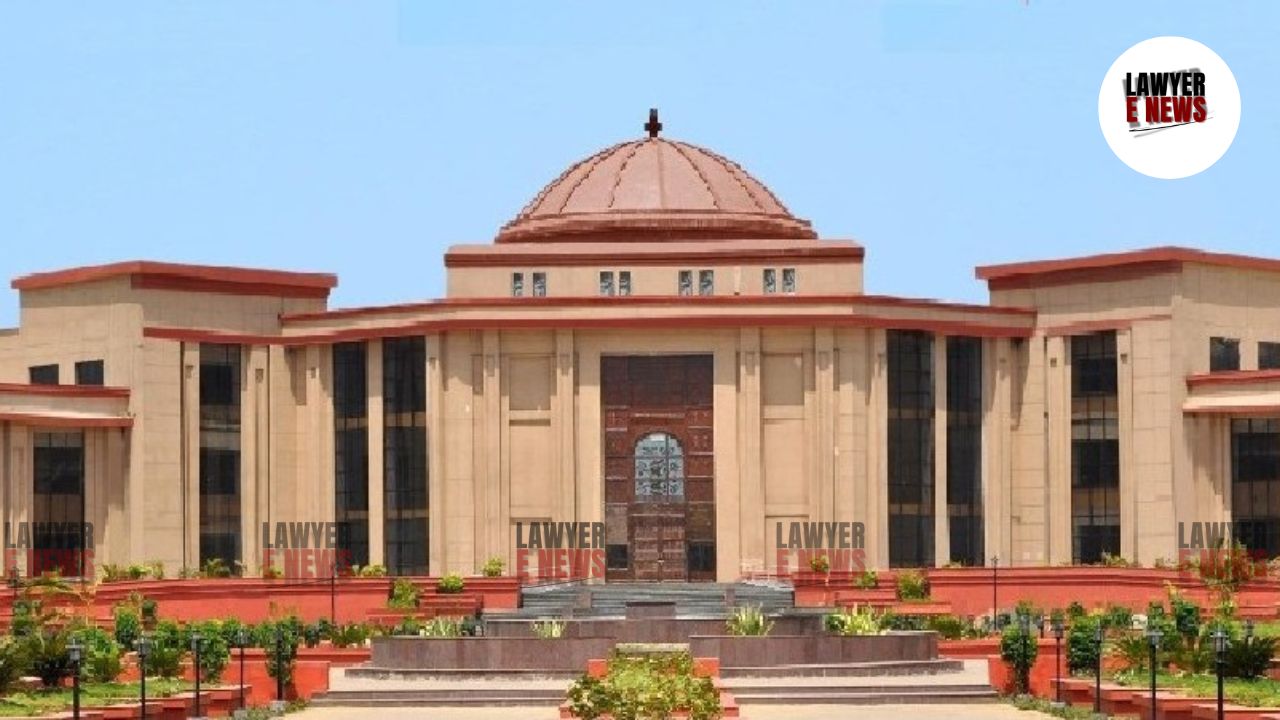
"Mere marking of a document as an exhibit does not amount to its admission in evidence when the objection regarding stamp duty is kept open. Once the Court, at the stage of final adjudication, holds the document to be inadmissible, Section 36 does not come to the aid of the party relying upon such document," High Court of Chhattisgarh at Bilaspur, in a judgment, has affirmed that an agreement to sell which records the delivery of possession to the purchaser must be stamped as a 'conveyance' under the Indian Stamp Act, 1899.
A division bench comprising Justice Rajani Dubey and Justice Amitendra Kishore Prasad held that the failure to pay the requisite stamp duty on such an instrument renders it inadmissible in evidence for any purpose, including for seeking specific performance. The Court further clarified that the bar under Section 36 of the Stamp Act, which prevents challenging the admission of a document once it is exhibited, does not apply if the trial court specifically reserves the question of admissibility for the final judgment stage.
The appellant, Swadhin Nag Chaudhary, had filed a civil suit for specific performance against the respondent, Ajay Francis, based on an agreement to sell dated November 26, 2013, concerning immovable property in Bilaspur. The Trial Court dismissed the suit, holding that the agreement (Ex. P/10) was insufficiently stamped and therefore inadmissible, while also finding that the appellant failed to prove his continuous readiness and willingness to perform the contract. Aggrieved by this dismissal and the partial refund of only Rs. 5 Lakhs as earnest money, the appellant moved the High Court in a first appeal.
The primary question before the Court was whether an agreement to sell recording delivery of possession attracts stamp duty as a 'conveyance' under Sections 2(10) and 2(11) of the Indian Stamp Act. The Court also considered whether the marking of such a document as an exhibit, despite a pending objection on stamp duty, precludes the court from discarding it at the final judgment stage under Section 36. Furthermore, the bench examined the mandatory requirements of proving continuous readiness and willingness under Section 16(c) of the Specific Relief Act, 1963.
Agreement to sell with possession constitutes 'Conveyance'
The Court observed that the recitals of the agreement dated November 26, 2013, and the admissions made by the appellant himself clearly established that possession of the suit property had been delivered to him. The bench noted that the appellant had even dug a borewell on the land after taking possession. Such a document, the Court held, is not a mere agreement to sell but is a document evidencing transfer of possession in part performance of the contract.
Consequently, the instrument attracted stamp duty as a 'conveyance' under the definitions provided in the Indian Stamp Act. The Court emphasized that when an instrument is chargeable with stamp duty and is not duly stamped, Section 35 of the Act creates an absolute bar against its admission in evidence for any purpose.
"An instrument which is chargeable with stamp duty and is not duly stamped cannot be admitted in evidence for any purpose, except as provided under law."
Section 36 bar not applicable when objection to stamp duty is kept open
Addressing the appellant's contention that the document was already marked as an exhibit and thus could not be discarded due to Section 36 of the Stamp Act, the High Court held this reliance to be misplaced. The record revealed that the respondent had raised an objection to the admissibility of the document at the earliest stage. The Trial Court had consciously marked the document as an exhibit while observing that its admissibility would be decided at the stage of final judgment.
The Court held that such a conditional marking does not amount to a final admission in evidence. Relying on the Supreme Court's decision in Avinash Kumar Chauhan v. Vijay Krishna Mishra, the bench reiterated that the court is duty-bound to impound a document that appears to be insufficiently stamped. The bench noted that the appellant, despite being aware of the objection, took no effective steps during the trial to seek impounding or to cure the defect.
"Once the Court, at the stage of final adjudication, holds the document to be inadmissible, Section 36 does not come to the aid of the party relying upon such document."
Continuous readiness and willingness a mandatory prerequisite
The High Court further delved into the requirements of Section 16(c) of the Specific Relief Act, 1963. It observed that readiness and willingness are two distinct elements; 'readiness' refers to the financial capacity to pay the consideration, while 'willingness' refers to the conduct and intention of the party. The bench held that the appellant failed to produce cogent evidence to show his capacity or his proactive steps to conclude the sale deed.
Citing the recent Supreme Court judgment in Pydi Ramana Alias Ramulu Vs. Davarasety Manmadha Rao, the bench noted that a plaintiff must prove continuous readiness and willingness from the date of the agreement till the final disposal of the suit. In this case, the appellant remained silent for long periods and failed to show that he had the funds or the genuine intent to complete the transaction, rendering the relief of specific performance unavailable.
"Readiness and willingness cannot be presumed and must be proved by cogent evidence... The finding on Issue No. 6 is thus based on proper appreciation of evidence and does not suffer from perversity."
The High Court concluded that there was no illegality in the Trial Court's approach in discarding the inadmissible agreement and denying the discretionary relief of specific performance. The bench affirmed the Trial Court's direction for the refund of Rs. 5 Lakhs while rejecting the additional claim of Rs. 2 Lakhs due to lack of evidence. The First Appeal was dismissed, and the judgment of the Trial Court was upheld in its entirety.
Date of Decision: 09 January 2026





