
-
by sayum
28 August 2026 2:11 PM







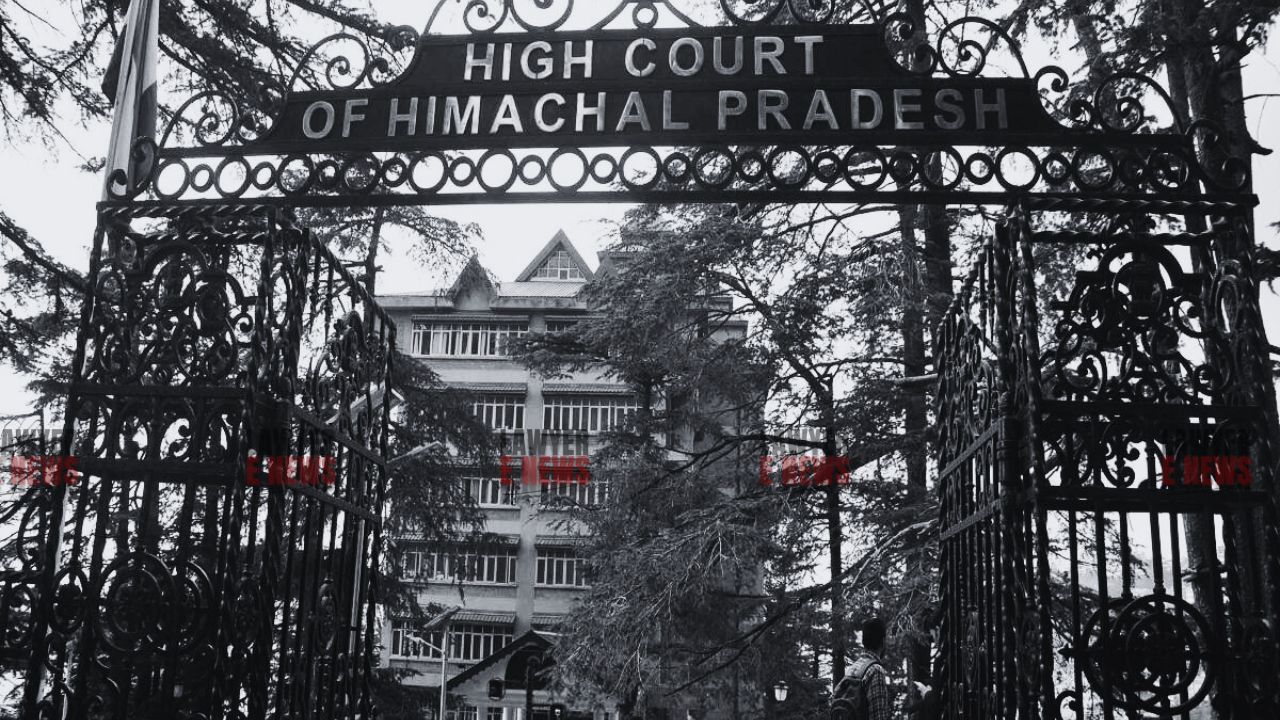
In a significant judgment Himachal Pradesh High Court declined to interfere with the acquittal of two accused charged under Sections 336, 427, 447, 506, and 34 of the Indian Penal Code along with Section 3(v) of the Scheduled Castes and Scheduled Tribes (Prevention of Atrocities) Act, 1989. Justice Rakesh Kainthla held that the trial court’s reasoning was not perverse and that acquittal could not be reversed in absence of “misreading or omission to consider material evidence.”
The Court emphasised that in criminal jurisprudence, "the acquittal of the accused further strengthens the presumption of innocence," and cited a line of authoritative precedents, including Chandrappa v. State of Karnataka, Surendra Singh v. State of Uttarakhand and Rajesh Prasad v. State of Bihar, reiterating that “if two reasonable views are possible on the evidence, the one supporting the acquittal must be allowed to stand.”
“People Do Not Ordinarily Act in Unison Like a Greek Chorus” – Court Discards Generalised Allegations of Caste-Based Abuse
Rejecting the application of Section 3(v) of the SC/ST Act, the Court came down heavily on the prosecution’s reliance on non-specific and omnibus allegations of caste-based abuse. The witnesses had not attributed any specific casteist statement to either Jagdish or Naresh individually but collectively accused both of abusing the complainant in the name of caste.
Citing the classic principle laid down in Pandurang v. State of Hyderabad, AIR 1955 SC 216, Justice Kainthla observed: “People do not ordinarily act in unison like a Greek chorus… Witnesses are often apt to say ‘all’ even when they only saw ‘some’. Unless a witness particularises when there are a number of accused, it is ordinarily unsafe to accept omnibus inclusions like this at their face value.”
The Court concluded that, “the generalised statement that the accused abused the informant in the name of caste cannot be relied upon.” It held that the prosecution failed to prove the caste-based abuse with the precision and specificity the law demands under the SC/ST Act.
Joint Ownership and Civil Injunction Defeated Charge of Criminal Trespass
The heart of the dispute revolved around a plot of land bearing Khasra No. 110, jointly purchased by the complainant Bhungar Ram Bhatia and accused Jagdish Chand. Both parties had purchased one biswa each in the year 2000. While Jagdish had already constructed a house, the complainant began construction in August 2008. The prosecution alleged that on 23.09.2008, the accused damaged four under-construction pillars, hurled stones at labourers, and made caste-based threats to prevent the complainant from building near them.
The Trial Court had acquitted the accused on the ground that the complainant failed to prove exclusive possession of the land. The demarcation report confirmed the land was jointly owned and no partition had occurred. Further, there was a civil injunction order restraining construction on the land. The High Court affirmed this reasoning, stating:
“The co-owner could not have raised construction without the consent of the other co-owners. Exclusive possession of the informant was not proved… the offence punishable under Section 447 IPC was not made out.”
“Men May Lie, but Circumstances Do Not” – Court Discredits Stone Pelting Claim Due to Absence of Physical Evidence
The Court also found that the allegation of stone pelting was unsupported by physical evidence. Although multiple witnesses claimed that the accused had pelted stones at labourers, no stones were recovered from the site, and neither the photographs nor the site plan showed any trace of stone debris. Justice Kainthla noted:
“It is trite to say that the men may lie, but circumstances do not; therefore, the absence of the stones on the spot falsifies the prosecution’s case.”
The Court found this absence particularly significant, especially when juxtaposed with the prosecution’s claim that the accused had used iron bars and sledgehammers to damage construction. Even the site plan and demarcation report did not corroborate the alleged damage.
Contradictions in Timeline and Exaggerated Damage Estimate Undermined Prosecution
The Court noted glaring inconsistencies among prosecution witnesses regarding the dates of construction of the pillars. While some claimed the pillars were constructed on 18th-20th August, others placed their completion on 27th September — four days after the alleged incident.
Photographs produced by the defence showed only iron bars and no visible construction of pillars. These photographs included a copy of the Divya Himachal newspaper dated 22.09.2008, proving the photographs were taken either on or after the date of the incident. Justice Kainthla found that “the presence of only iron bars in the photographs contradicts the prosecution’s claim that four completed pillars were damaged.”
Moreover, the Court was unconvinced by the prosecution’s claim of ₹2,00,850 in damage to two pillars when the entire house construction contract was worth ₹55,000. It held:
“It is not explained how the damage to two pillars could have resulted in the loss of ₹2,00,850/- when the contract for the construction of the whole house was for ₹55,000/-.”
This, the Court observed, created a serious credibility issue in the prosecution’s financial estimation of loss.
Appeal Dismissed – Trial Court’s Acquittal Held to be a Reasonable View Based on Evidence
Summing up the decision, the High Court held that the trial court’s view was legally sustainable, reasonable, and supported by the evidence on record. While acknowledging that an appellate court has full power to reappreciate evidence, the Court reiterated:
“If the view taken is a possible view, the appellate court cannot overturn the order of acquittal on the ground that another view was also possible.”
Accordingly, the appeal was dismissed, and the acquittal of Jagdish Chand and Naresh Kumar was upheld.
The respondents were directed to furnish bail bonds of ₹25,000 each under Section 437-A CrPC (now Section 481 of the Bharatiya Nagarik Suraksha Sanhita, 2023) to remain effective for six months in case the State pursues a Special Leave Petition before the Supreme Court.
Date of Decision: 1st September 2025





