-
by sayum
28 August 2026 12:24 PM







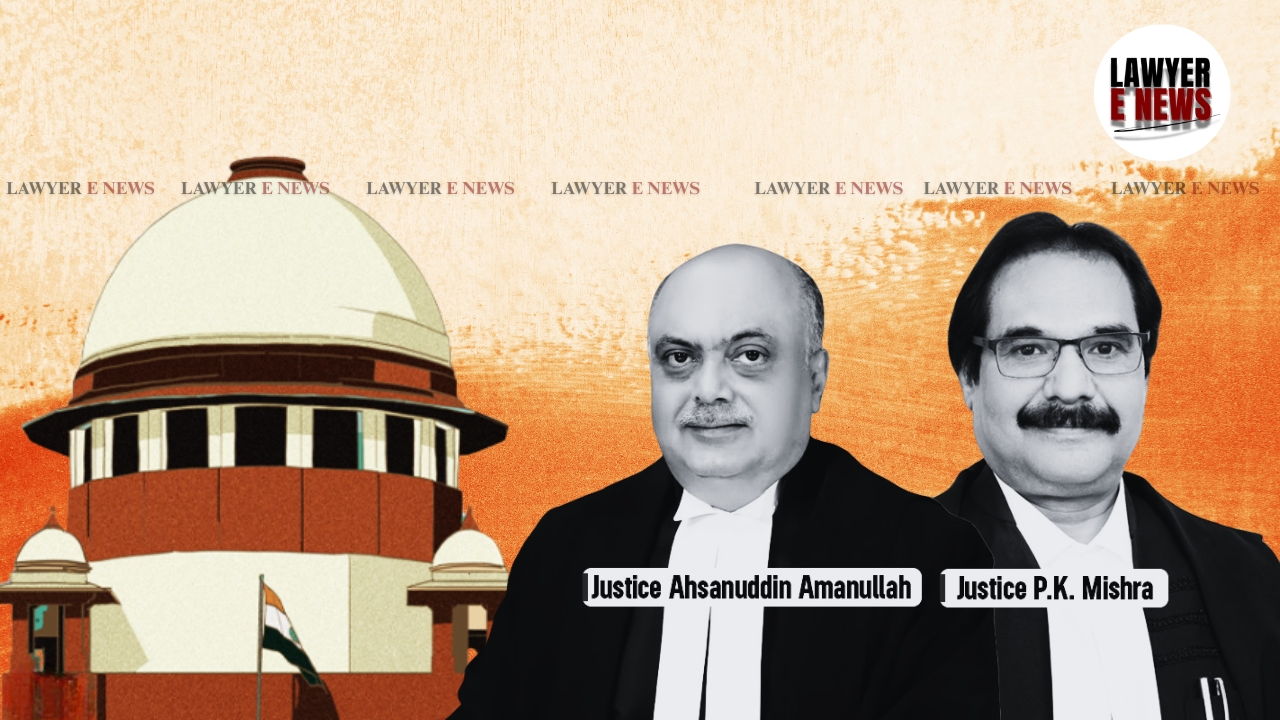
“Trusts Do Not Have Independent Legal Status Capable Of Being Sued; Complaint Against Trustee Valid Without Making Trust An Accused” – Apex Court. On October 9, 2025, the Supreme Court of India held that a Trust is not a juristic person under Indian law and that proceedings under Sections 138 and 141 of the Negotiable Instruments Act, 1881 are maintainable directly against a trustee who signs a dishonoured cheque, even if the Trust is not arraigned as an accused. The ruling was delivered by a Division Bench comprising Justice Ahsanuddin Amanullah and Justice Prashant Kumar Mishra, which set aside a 2022 judgment of the Meghalaya High Court that had quashed criminal proceedings on the ground of non-joinder of the Trust.
The Court emphatically declared, “A Trust is not a body corporate or juristic entity. It is not a legal person capable of being sued or suing. It functions entirely through its Trustees, who alone are answerable in law.” The judgment not only settles a crucial question of law but also resolves conflicting High Court decisions on the legal personality of Trusts under the NI Act.
"Trustees Are The Legal Actors – A Trust Is An Obligation, Not A Person" – Supreme Court Anchors Its Reasoning In Trusts Act
The case arose out of a cheque for ₹5 crore issued by the respondent, Chairman of Orion Education Trust, in favour of the appellant for services rendered during the management transition of William Carey University. The cheque was dishonoured due to insufficient funds, and a complaint was filed under Sections 138 and 141 of the NI Act and Section 420 IPC. The respondent argued that since Orion, the Trust, was not made an accused, the complaint was not maintainable.
The High Court of Meghalaya accepted this argument and quashed the criminal proceedings, but the Supreme Court reversed this view. Justice Amanullah, writing for the Bench, observed:
“It is clear that only a Trustee has the obligation to file, maintain and defend any suit on behalf of the Trust. Meaning thereby, that a Trust does not have a separate legal existence of its own, making it incapable of suing or being sued.”
The Court drew support from Sections 3 and 13 of the Indian Trusts Act, 1882, which define a Trust as an obligation linked to ownership of property for the benefit of others, and place the responsibility of defending suits solely on the trustees. The Court noted:
“A Trust, as defined under the Indian Trusts Act, is an obligation annexed to ownership. It is not a person recognised in law. It cannot sue or be sued. The Trustees are the ones who are liable and must maintain and defend suits.”
"Equating Trust With Company Is A Legal Fallacy" – Supreme Court Rejects View Of Trust As Juristic Person Under NI Act
In sharp disapproval of several High Court rulings that had treated Trusts as juristic entities akin to companies, the Court observed:
“The legal status accorded to a ‘company’ cannot be imported to a Trust. A Trust operates through Trustees, who are legal entities. The Trust itself is without any independent legal status.”
The Court referred to classic corporate jurisprudence laid down in Salomon v. Salomon & Co. Ltd. (1897), and reiterated by the Supreme Court in Tata Engineering & Locomotive Co. Ltd. v. State of Bihar (1964), to emphasise that a company has a legal personality separate from its members, which is not the case for Trusts.
It categorically held:
“The Trust is not like a corporation which has a legal existence of its own and therefore can appoint an agent. It is the Trustees alone, through whom the Trust funds or properties are managed and dealt with.”
The Court declared that contrary decisions rendered by various High Courts, including Prana Educational and Charitable Trust v. State of Kerala, Mukund v. Eknath Hatwar, and Bijaya Manjari Satpathy v. State of Orissa, which had held that a Trust was a juristic person liable under the NI Act, were incorrect in law and stood overruled.
“Signatory Of Cheque Is Directly Liable Under Section 141(2); No Need To Implead Trust” – Court Reiterates SMS Pharmaceuticals Doctrine
The Court reinforced the settled legal principle that the signatory of a dishonoured cheque is automatically liable under Section 141(2) of the NI Act, and no specific averment is necessary as to his role in the business conduct, especially when the cheque is signed in his capacity as trustee or authorised signatory.
Relying on SMS Pharmaceuticals Ltd. v. Neeta Bhalla (2005) and K.K. Ahuja v. V.K. Vora (2009), the Court held:
“A person who signs the cheque on behalf of the Trust is directly responsible for the act of dishonour and falls squarely under Section 141(2). There is no legal requirement to make a specific averment about responsibility in the complaint where the person is a signatory or occupies a position of control like a Chairman or Managing Trustee.”
The Bench also endorsed the reasoning from S.P. Mani & Mohan Dairy v. Dr. Snehalatha Elangovan (2023), reiterating that it is the accused who must demonstrate lack of knowledge or due diligence in order to escape criminal liability, not the complainant who must prove the inner workings of the Trust.
“No Requirement To Implead Trust In Complaint – Trustee Alone Can Be Prosecuted” – Apex Court Settles The Law
Concluding its legal analysis, the Court unequivocally held:
“When a cause of action arises due to dishonour of a cheque and a complaint is initiated under the NI Act, the same is maintainable against the Trustee who has signed the cheque, without the requirement to array the Trust also as an accused.”
Rejecting the High Court’s reasoning that the Trust, being the drawer, had to be made a party for the complaint to be valid, the Court held that such a requirement was both legally and conceptually misplaced, as a Trust has no separate legal personality to be made a party in the first place.
It declared:
“A Trust not being a legal entity cannot be arraigned as an accused. It is only through Trustees that a Trust acts, and it is they who are responsible and liable under law for any acts done on behalf of the Trust.”
“Judicial Discipline Must Prevail: Later Benches Cannot Override Coordinate Precedent” – Supreme Court Reprimands High Court For Ignoring Earlier Binding Ruling
The Court also took the opportunity to censure the Kerala High Court's reasoning in Prana Educational Trust, where it had declined to follow an earlier binding decision of the same Court in K.P. Shibu v. State of Kerala, stating it was “not so elaborative”.
The Bench was categorical:
“It was not open to the learned Judge in Prana Educational and Charitable Trust to prefer the view expressed by other High Courts over a coordinate Bench of its own Court. Judicial discipline requires reference to a larger Bench if disagreement exists.”
Citing National Insurance Co. Ltd. v. Pranay Sethi (2017) and Union Territory of Ladakh v. Jammu & Kashmir National Conference (2023), the Court emphasised that in case of conflict between co-equal benches, the earlier decision must be followed, unless overruled or declared per incuriam.
“Pending Reference In Pratibha Pratisthan Does Not Halt Application Of Law” – Existing Precedent Still Binding Until Overruled
The Court clarified that its reasoning remained unaffected by the fact that the ruling in Pratibha Pratisthan v. Canara Bank (2017), which held that a Trust is not a person under the Consumer Protection Act, is under consideration before a Larger Bench.
The Bench held:
“Till the reference is decided one way or the other, the law as declared in Pratibha Pratisthan continues to hold the field. High Courts must proceed to decide cases on the basis of existing law.”
Citing Union Territory of Ladakh, the Court reinforced that pending references do not suspend the binding nature of existing Supreme Court precedents, unless specifically directed.
Final Verdict: High Court Judgment Set Aside – Complaint Restored – Trial To Proceed With Expedition
Allowing the appeal, the Court set aside the Meghalaya High Court’s judgment and directed that Criminal Case No. 44(S)/2019 be restored and proceeded with according to law.
“The impugned judgment is unsustainable. We have no hesitation in quashing it. The subject proceeding is restored to its original file and number, to be proceeded with by the Trial Court. As the matter dates back to 2019, we expect the Court to act with due expedition.”
The Court concluded by noting that its ruling is confined to the context of the NI Act and does not decide the broader question of whether a Trust can be sued in other contexts.
Date of Decision: October 9, 2025