-
by sayum
28 August 2026 8:44 AM







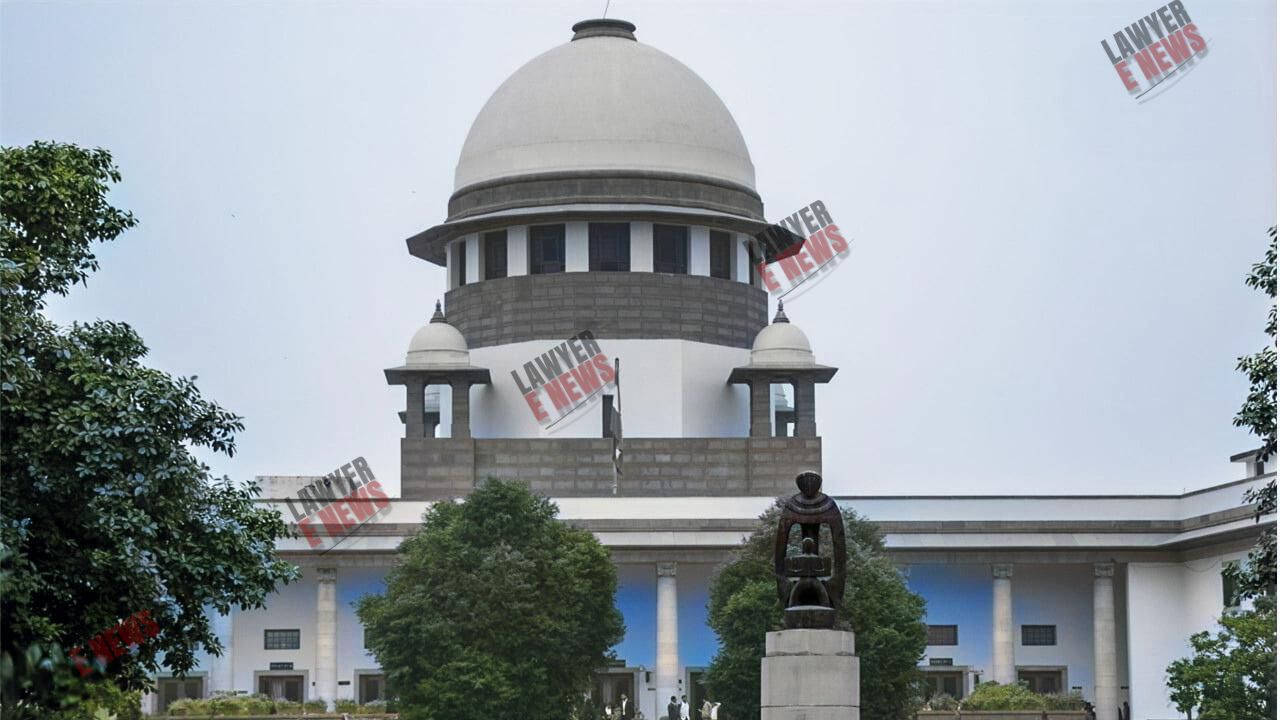
“There Can Be No Adjudication Without Communication — Jurisdiction Cannot Arise From Constructive Knowledge” - In a significant ruling Supreme Court of India decisively clarified the distinction between “irregularity” and “invalidity” in service of summons under Order IX Rule 13 of the Code of Civil Procedure (CPC). The Court held that a decree passed without proper service of summons is not merely defective — it is a nullity in law, incapable of sustaining any further proceedings.
Rejecting the argument that Amazon Technologies Inc. had “constructive notice” of the suit via informal email exchanges, the Court ruled that strict compliance with service provisions under Order V CPC is mandatory. In its detailed reasoning, the Court observed that jurisdiction arises only after lawful service — and not from assumptions, convenience, or mere awareness.
“A Party Cannot Be Said To Have Notice Unless Served In The Manner Prescribed By Law”
The case arose from a trademark infringement suit initiated by Lifestyle International Pvt. Ltd. against Amazon Technologies Inc. and others. The Single Judge of the Delhi High Court had passed a ₹3360 crore ex parte money decree against Amazon Technologies after holding that the company had failed to appear. The High Court had assumed that Amazon was aware of the proceedings based on prior legal communications with other group entities.
However, the Supreme Court categorically held that such inferences cannot substitute the legal requirement of valid service. It stated:
“There is no evidence on record to show valid service of summons upon the appellant. The learned Single Judge proceeded ex parte erroneously.”
The Court emphasized that unless a defendant is served in accordance with Order V CPC, the court does not acquire jurisdiction to proceed ex parte, regardless of whether the party may have had knowledge of the case informally.
“Invalid Service Strikes At The Root — It Is Not A Curable Irregularity”
Delving into Order IX Rule 13 CPC, the Court distinguished between an “irregularity” in service — which may not vitiate the proceedings — and an “invalid or non-existent” service, which deprives the court of jurisdiction altogether.
It observed: “It is well-settled that if there is total absence of valid service of summons, the decree passed in such proceedings is a nullity. This is not a case of procedural irregularity but one of jurisdictional illegality.”
The Court reaffirmed that a decree passed in the absence of lawful notice amounts to a violation of natural justice, and no presumption of correctness can be drawn in such a situation. The error goes to the very foundation of the adjudication and must be treated as incurable.
“Constructive Notice Is No Substitute For Statutory Service”
Lifestyle International had argued that since Amazon Technologies was part of the same corporate group as Cloudtail and Amazon Seller Services, and had communicated via legal emails during the litigation, it must be treated as having constructive notice.
The Supreme Court rejected this, stating:
“Constructive knowledge cannot replace the requirement of due service. The principle of audi alteram partem demands actual notice — not assumed awareness.”
The Court warned against diluting procedural safeguards in cases involving large multinational entities. Even in such commercial disputes, substantive justice must follow procedural fairness, and status of the party cannot lower the standards of service of process.
“Once The Defendant Shows No Summons Were Served, The Burden Shifts To The Plaintiff”
The judgment also clarified the burden of proof under Order IX Rule 13 CPC. Once a defendant asserts that they were not served, the onus shifts to the plaintiff to establish valid service. In the Amazon case, there was no service report, no affidavit, and no compliance with the rules for service on foreign corporations.
“In the absence of any documentary proof showing service as per law, the finding that the defendant was served is per se unsustainable.”
This clarification aligns with settled law that procedural rules regarding service must be strictly followed, especially when ex parte decrees of such enormous magnitude are passed.
“Jurisdiction Is Not A Matter Of Assumption — It Must Be Invoked Lawfully Through Notice”
The Court also reinforced the jurisprudential principle that jurisdiction cannot be assumed merely because a defendant is a known party to the transaction or litigation. Jurisdiction must be invoked, and the process begins with proper and lawful service of summons.
“The civil court derives jurisdiction over a defendant only upon lawful service. Any action taken without this foundational step lacks legal authority.”
This holding reaffirms that service of summons is not a technicality, but a constitutional imperative under principles of natural justice.
Valid Service Of Summons Is The Bedrock Of Fair Trial — Not A Procedural Luxury
With this ruling, the Supreme Court has reaffirmed that fair trial begins with fair notice. In holding that invalid service is not a procedural irregularity but a jurisdictional defect, the Court has strengthened procedural discipline in civil litigation, especially in cases involving ex parte decrees.
The judgment provides crucial guidance to courts across the country: do not bypass the mandatory requirements of service, and do not presume notice from informal communication or group entity involvement. A decree passed in violation of this principle is not merely defective — it is void.
This decision will serve as a binding precedent on the critical distinction between irregularity and invalidity under Order IX Rule 13 CPC, and reasserts that procedural fairness is indispensable, even in high-value, high-stakes commercial disputes.
Date of Decision: October 7, 2025